

Stories by @theamericanalligator
215 stories
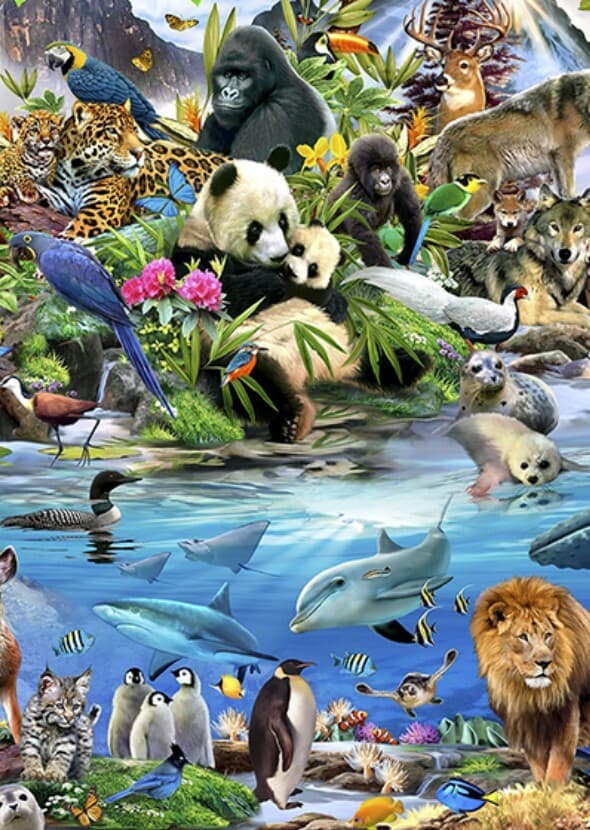
Wildlife
Wildlife refers to undomesticated animal species, but has come to include all organisms that grow or live wild in an area without being introduced by humans.[1] Wildlife was also synonymous to game: those birds and mammals that were hunted for sport. Wildlife can be found in all ecosystems. Deserts, plains, grasslands, woodlands, forests, and other areas, including the most developed urban areas, all have distinct forms of wildlife. While the term in popular culture usually refers to animals that are untouched by human factors, most scientists agree that much wildlife is affected by human activities.[2] Some wildlife threaten human safety, health, property, and quality of life. However, many wild animals, even the dangerous ones, have value to human beings. This value might be economic, educational, or emotional in nature.

A World of Wildlife
Around the World, We'll be discovering some of the most fascinating animals. A Celebrity Will Narrate a Mammal, Fish, Reptile, Bird, and Amphibian.

Wildlife of the World
With an inspiring foreword by leading naturalist and wildlife photographer Chris Packham, this epic adventure takes you across the continents to meet all creatures big and small. You’ll visit the deserts of Australia, the grasslands of Africa, the rainforests of South America, the mountains of Asia, and the coral reefs of Australia on this mind-blowing tour to meet the incredibly diverse range of life on Earth. Breathtaking photography, animal profiles, accessible maps, and facts and stats combine to create this standout reference title. Revealing a wealth of species across hundreds of spectacular pages, Wildlife of the World introduces you to animals that roam, swim, and fly in each and every part of our planet.

Animal Kingdom
Most living animal species belong to the infrakingdom Bilateria, a highly proliferative clade whose members have a bilaterally symmetric body plan. Extant bilaterians include the basal group Xenacoelomorpha, but the vast majority belong to two large superphyla: the protostomes, which include phyla such as arthropods, molluscs, flatworms, annelids and nematodes, etc.; and the deuterostomes, which include the three phyla echinoderms, hemichordates and chordates, the latter with the vertebrates being its most successful subphylum. Precambrian life forms interpreted as early complex animals were already present in the Ediacaran biota of the late Proterozoic, but fossils of primitive sponge and other speculative early animals have been dated to as early as the Tonian period. Nearly all modern animal phyla became clearly established in the fossil record as marine species during the Cambrian explosion, which began around 539 million years ago (Mya), and most classes during the Ordovician radiation 485.4 Mya. 6,331 groups of genes common to all living animals have been identified; these may have arisen from a single common ancestor that lived 650 Mya during the Cryogenian period.

Wild Nature
A Celebrity Narrates an Animal from Around the World.

The Perfect Nature Documentary Series
Let us all suggest actors to play the roles for our Perfect Nature Documentary Series! Alive or Deceased actors are allowed!

Animals
Most living animal species belong to the infrakingdom Bilateria, a highly proliferative clade whose members have a bilaterally symmetric body plan. Extant bilaterians include the basal group Xenacoelomorpha, but the vast majority belong to two large superphyla: the protostomes, which include phyla such as arthropods, molluscs, flatworms, annelids and nematodes, etc.; and the deuterostomes, which include the three phyla echinoderms, hemichordates and chordates, the latter with the vertebrates being its most successful subphylum. Precambrian life forms interpreted as early complex animals were already present in the Ediacaran biota of the late Proterozoic, but fossils of primitive sponge and other speculative early animals have been dated to as early as the Tonian period. Nearly all modern animal phyla became clearly established in the fossil record as marine species during the Cambrian explosion, which began around 539 million years ago (Mya), and most classes during the Ordovician radiation 485.4 Mya. 6,331 groups of genes common to all living animals have been identified; these may have arisen from a single common ancestor that lived 650 Mya during the Cryogenian period.

Animals on Earth
Scientists have recently estimated that there are approximately 8.7 million species on Earth. They believe that 1-2 million of those species are animals. And what do we know about all those species? Not much! The same study estimates that 86% of all land species and 91% of all sea species have not yet been discovered or described.

Hello World: Animals
Discover some of the most incredible creatures on Earth in this interactive atlas of world wildlife! Featuring more than 180 animals from a variety of habitats, with flaps to lift on every spread, this stunning book offers exploration many wonders of the natural world.

Animals of the World
An expert reference guide to 840 amphibians, reptiles and mammals from every continent. It is a comprehensive encyclopedia of over 840 animals from North and South America, Africa, Europe, Asia and Australia, all beautifully illustrated with over 1000 commissioned artworks and photographs, and over 800 distribution maps. From the smallest mouse to the largest whale, this book offers a detailed and thorough guide to an array of reptiles, amphibians and mammals, exploring their habits and habitats.

Wild Nature
A Celebrity Narrates an Animal from Around the World.

Animals around the World
Our guide to the most unique animals around the world will provide fascinating and fun facts on animals from around the world. Here you will read about the most common and the most endangered animals as well as the most impressive wildlife of many different countries. There are about 15 million animal species on our planet, and some say there are even many more! Only 2 million species are known or have been classified so far. Every year new species are discovered, described and named. Africa is known as the continent with the most varied wildlife and the most animal species. If one considers countries, Indonesia on the Asian continent is referred to as the most biodiverse country of the world and has the largest number of mammal species on our planet. Australia on the other hand, is known for its variety of marine life and the highest number of fish species.

Endangered Animals
An endangered species is a type of organism that is threatened by extinction. Species become endangered for two main reasons: loss of habitat and loss of genetic variation.

Animal Planet
Animal Planet is an American multinational pay television channel, and associated AnimalPlanet.com website content, owned by the Warner Bros. Discovery Networks unit of Warner Bros. Discovery.

National Geographic's Wild
National Geographic Wild is a global pay television network owned by National Geographic Partners, a joint venture between The Walt Disney Company and the National Geographic Society. The channel primarily focuses on wildlife and natural history non-fiction programming.