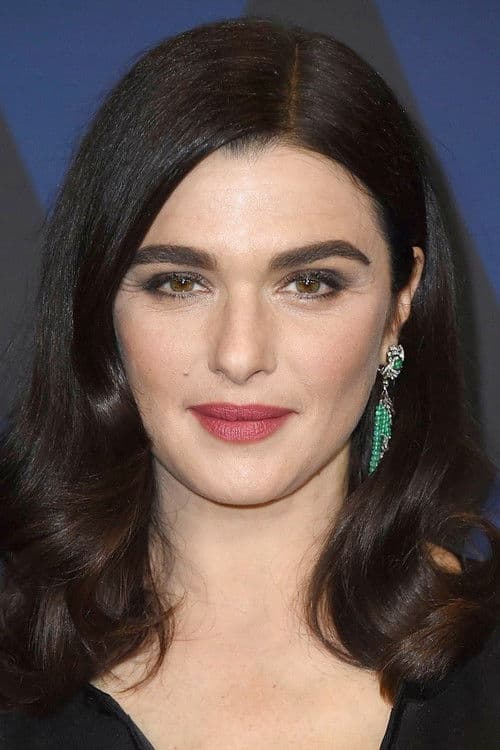
Age: 56
female
Rachel Hannah Weisz (/vaɪs/; born 7 March 1970) is an English actress. Known for her roles in independent films and blockbusters, she has received several awards, including an Academy Award, a BAFTA Award, a Golden Globe Award, and a Laurence Olivier Award. Weisz began acting in stage and television productions in the early 1990s and made her film debut in Death Machine (1994). She won a Critics' Circle Theatre Award for her role in the 1994 revival of Noël Coward's play Design for Living. She went on to appear in the 1999 Donmar Warehouse production of Tennessee Williams' drama Suddenly Last Summer. Her film breakthrough came with her starring role as Evelyn Carnahan in the Hollywood action films The Mummy (1999) and The Mummy Returns(2001). Weisz went on to star in several films of the 2000s, including Enemy at the Gates (2001), About a Boy (2002), Runaway Jury (2003), Constantine (2005), The Fountain (2006), The Lovely Bones (2009) and The Whistleblower (2010). For her performance as an activist in the 2005 thriller The Constant Gardener, she won the Academy Award for Best Supporting Actress. For playing Blanche DuBois in a 2009 revival of A Streetcar Named Desire, she won the Laurence Olivier Award for Best Actress. In the 2010s, Weisz continued to star in big-budget films such as the action film The Bourne Legacy (2012) and the fantasy film Oz the Great and Powerful (2013) and achieved critical acclaim for her performances in the independent films The Deep Blue Sea (2011), Denial (2016), and The Favourite (2018). For her portrayal of Sarah Churchill in The Favourite, she won the BAFTA Award for Best Actress in a Supporting Role and received a second Academy Award nomination. Weisz portrayed Melina Vostokoff in the Marvel Cinematic Universe film Black Widow (2021) and starred as twin obstetricians in the thriller miniseries Dead Ringers (2023). Description above from the Wikipedia article Wendell Pierce, licensed under CC-BY-SA, full list of contributors on Wikipedia.
Rachel Weisz
Olympe de Gouges
for Olympe de Gouges in The French Revolution
Suggested by monkey2

It is 1789 and France is beset by a number of problems. The treasury is empty and the country is facing bankruptcy. While the majority of the common people live in unimaginable poverty, the nobility and the clergy do not have to pay taxes and are living in luxury. In this situation, King Louis XVI decides to convene the Estates-General at Versailles. The negotiations go nowhere, so the Third Estate decides to invite the other Estates to join it, and a National Assembly is proclaimed. Some of the nobility and clergy do indeed join. All involved swear not to disperse until a constitution is drawn up. On July 9, 1789, this assembly declared itself the Constituent National Assembly. In this situation, King Louis XVI decides to send troops to Versailles. In protest against this move, the Parisians storm the royal armoury. Here they seize thousands of rifles and form a militia. Early in the morning of 14 July 1789, they attack the Bastille, a symbol of royal oppression. After a five-hour battle, they succeed in taking the prison. Thus begins the Great French Revolution, which changed Europe forever. An event that brought many progressive ideas, but also a bloody terror that eventually brought not only King Louis XVI to the guillotine, but also most of the leaders of the revolution itself. P.S., In my opinion, it would be best to treat this topic in the form of a historical miniseries on HBO MAX or Amazon Prime, for example.
Loading comments...